
INTRODUCTION
India is especially known for its rich culture and heritage; the intricate artwork used in storytelling through the ages, the vibrant colours and all the cleverly developed art techniques, like block printing, are characteristic to the traditional Indian art.
“…raw, rustic, poised, entertaining, cinematic, exuberant.”
– Vibhor
The quote above is probably the most evocative and accurate description of traditional Indian art; it encapsulates the essence perfectly. Traditional Indian designs are truly a sight to behold, owing to the intricate detailing and raw depictions that have a story to tell. There is much to explore when it comes to traditional designs in India because of the diversity in culture; every region has its own characteristic traditional art style, for example, Warli paintings from Maharashtra and Pichwai paintings from Rajasthan.
Despite the diversity in traditional Indian art, they are all somewhat visually similar and are an ‘entertaining’ and ‘cinematic’ experience for the audience, as described by Vibhor.
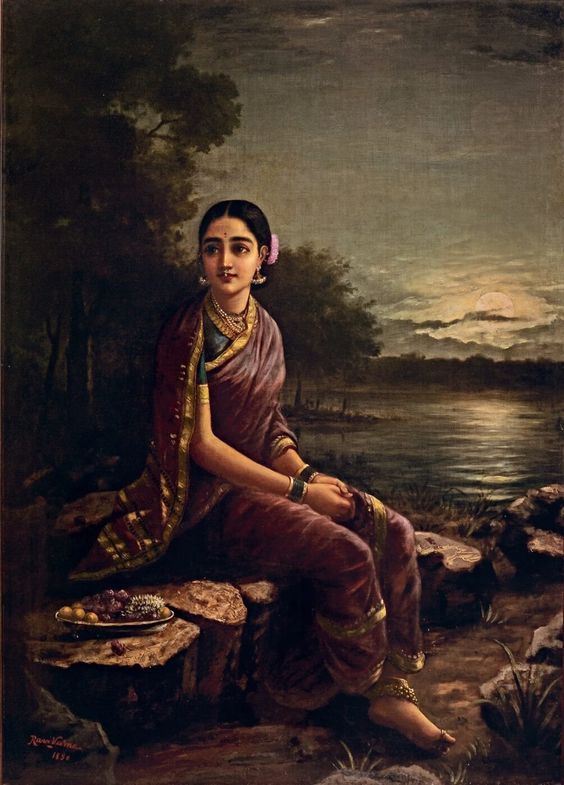
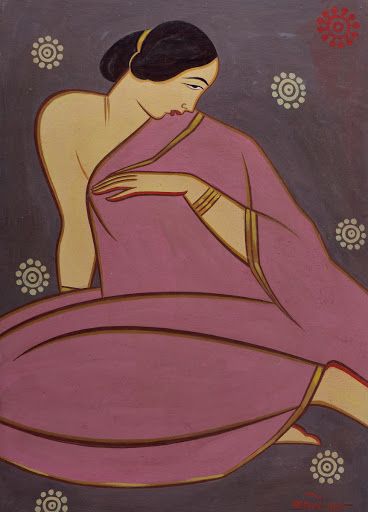
- (Left) Radha in the Moonlight, Raja’s Ravi Varma’s most admired piece and one of the most expensive paintings in India. Raja Ravi Varma was especially known for his emotive and vivid paintings with ambient settings; each painting is an experience in itself.
- (Right) Lady in a Pink Sari by Jamini Roy. Jamini Roy has a simple and unique style that combines Indian folk art style with modern elements.
THE VALUES & ESSENCE OF INDIAN ART & DESIGN
Indian traditional art and design is primarily bold, expressive and striking. The goal is always to communicate; to pass on knowledge; to tell a story.
Traditional art and design in India values organicity, nature, sustainability, functionality and utility, unity and belongingness, harmony, spirituality, tradition, innovation and education. All art forms all over the country are true to these values.
Apart from these, Indian art and design is known for its seemingly complex and well-detailed, yet simple designs, composition and proportions, absolute visual balance and harmony and extensive use of symbolism. It provides an immersive and engaging experience to the audience.
The ethos or the essence of Indian traditional art and design lies in the highly human-centred designs; they are all so flexible, versatile and cater to diverse populations and it is evident in the design of the utensils, machines and clothing, etc. The focus is on the interaction of humans with the world around and with each other to create intuitive designs that efficiently solve problems and add value.
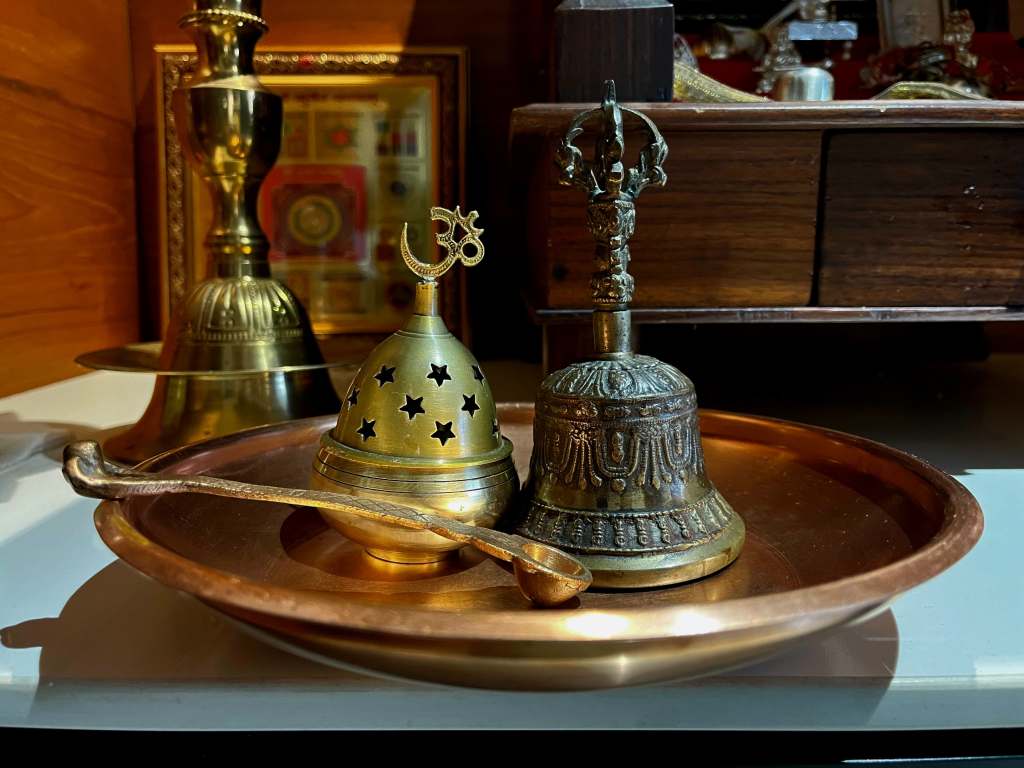
Indian art draws inspiration from the natural world around us. All Indian designs and their smaller design elements resemble some natural form or shape, reminding us that we are derived from and a part of the same natural world.
“…It should be liberating for both, the designer, and the form…”
– Shruthi Sancheti
INDIAN INFLUENCE ON UI/UX DESIGN
India has a lot to offer in the area of design, especially in modern digital design of user interface/ experience (UI/UX).
Visual interest is the primary feature of a good design, along with function. Indian traditional designs use a lot of bold and vibrant colours, like reds, greens, yellows, blacks, blues, etc.; a lot of primary colours are seen in the art, from mural paintings and palace interiors to clothing, like Paithani sarees.
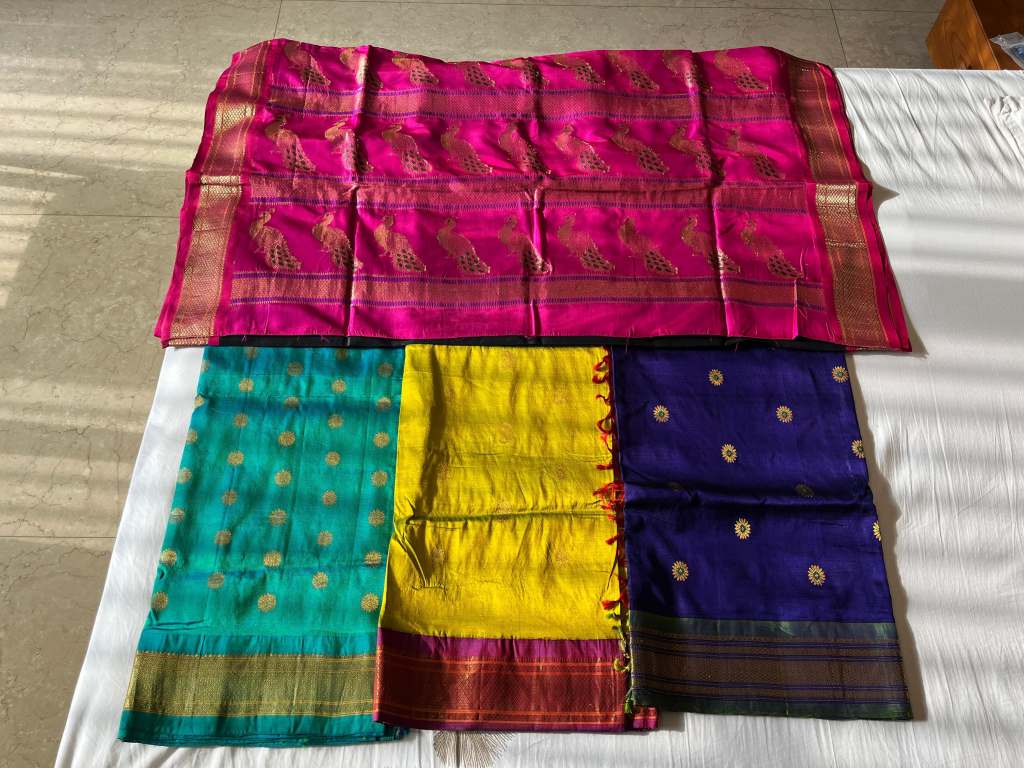
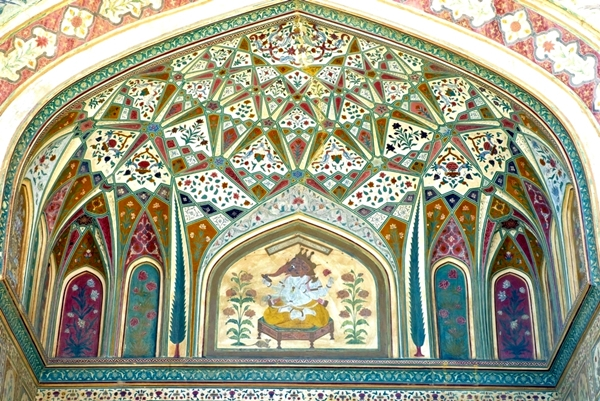
1. (Top left) Paithani sarees
2. (Top right) Inside the Amber palace in Jaipur. Source: https://pinkcity.com/amber/amber-fort-facts-and-sheesh-mahal-in-amber-fort/
The designs and depictions also make great use of the interplay between colours to create contrast (figure-ground principle of design). Apart from the contrast of colours, what makes Indian designs so visually interesting is the visual depth in the art. Indian art is always so intricate and well-detailed that it automatically catches the eye of the audience and holds them in a standstill. Despite being so intricate and complex, it is never too overwhelming to the eye: when broken down, a painting is made of very simple and basic shapes (circles, paisleys, tear drops, leaves, etc.) – this helps retain the simplicity while maintaining the decadence.
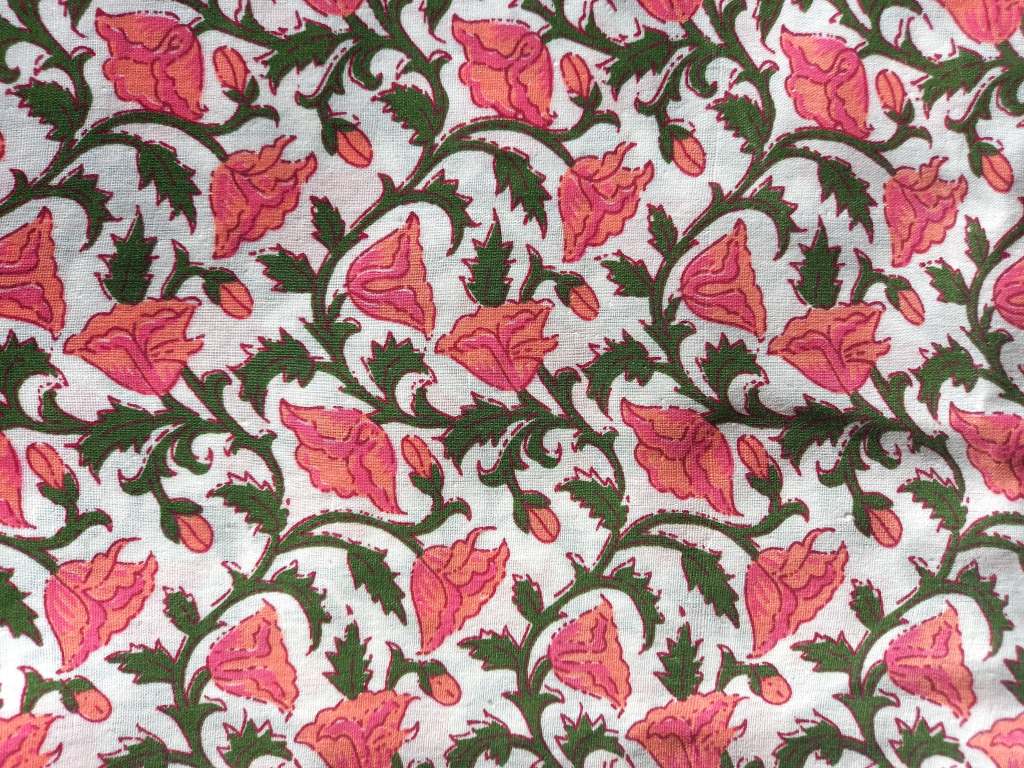
A lot of Indian designs are repetitive; a single, simple pattern is repeated over a large area (repetition principle of design). This creates a seeming complex and interesting pattern, excellent for filling empty spaces or creating a simple but appealing background. This technique of repetition is commonly seen as repeating motifs in the textile industry or in mandala art, where a simple design or design element is repeated radially or concentrically.
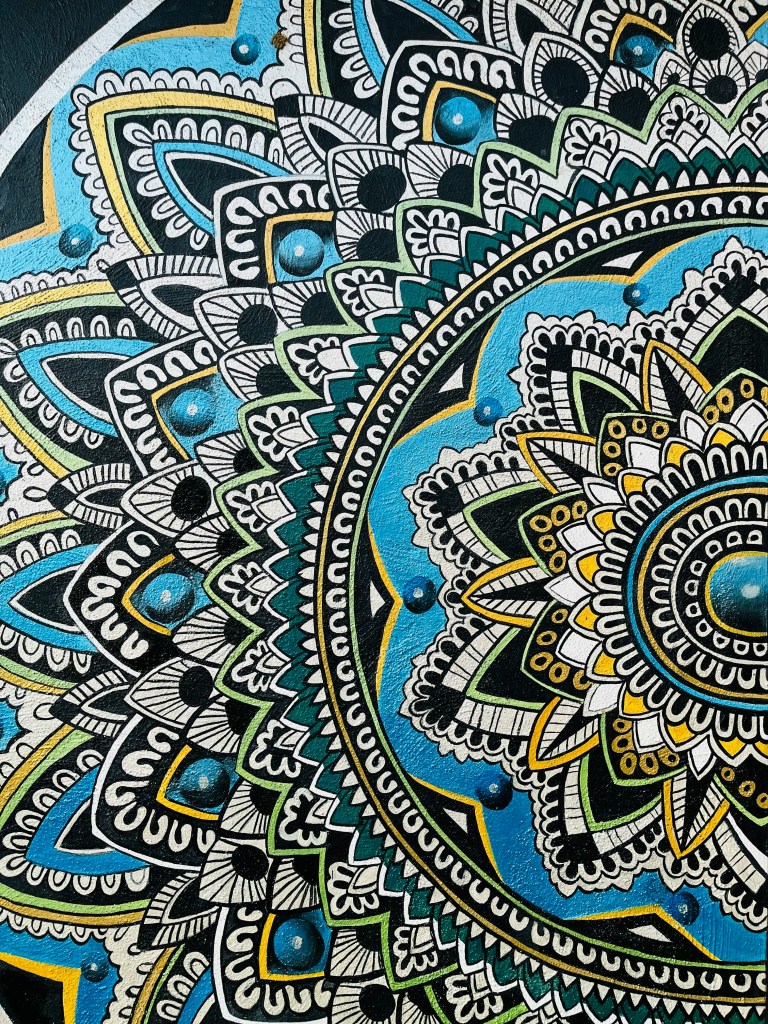
1. (Left) Mandala art; Source: Vecteezy
2. (Right) A repetitive motif pattern on a fabric
Storytelling has always been a big part of the culture and so Indian traditional art and design is mainly based on symbolism and iconography. All designs and depictions seen all around the country are essentially symbolic in nature. They all communicate information/ knowledge to the succeeding generations symbolically, be it knowledge or historical events.
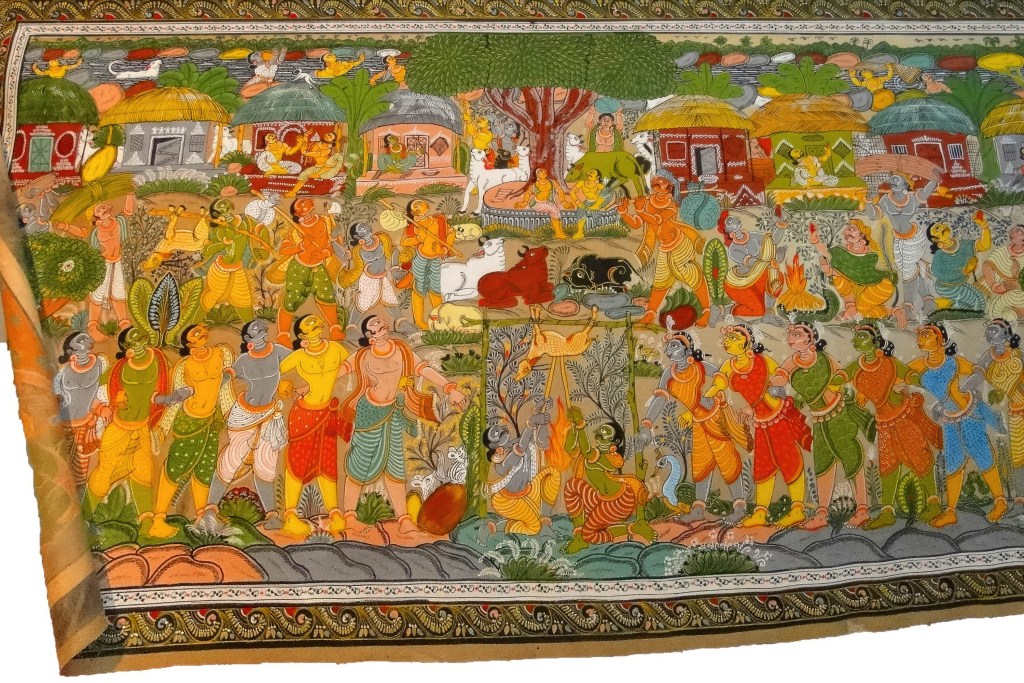
Similarly, a good user design or good iconography is able to clearly communicate the message/ information/ knowledge to the user or audience. It is important to design an interface that can easily be understood by a diverse population. What makes symbols so effective in communication is that they are simple and succinct, yet very expressive and universally understood.
Traditional Indian art uses a lot of ‘Rekha’ (design element of line, the primordial element), ‘Shunyata’ (design principle of space) and ‘Bindu’ (circle, dot, point or the focal point of creation). All of these are culturally significant, symbolic too, and are extensively used in traditional art and design and in daily objects.
THE LOTA: A CASE STUDY ON THE MOST ICONIC INDIAN PRODUCT DESIGN
India boasts of some of the best examples of human-centred product design developed in ancient times, which also have a deep cultural and religious significance.
“It should definitely not emulate truck art or matchbox art; Indian design is more flexible, like the Lota.”
-Bhavyajeet
Why Indian traditional designs are so exemplary is because they are so flexible and therefore, very practical, versatile and catering to diversity.
The Lota is probably the oldest and most iconic example of excellent product design in India.
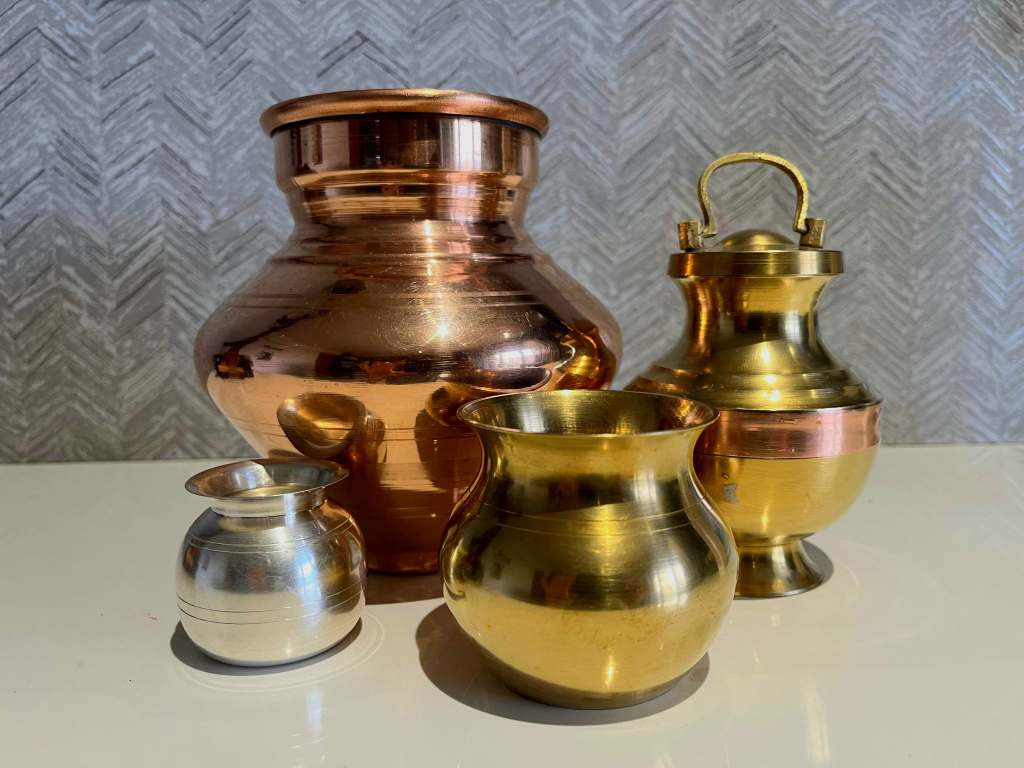
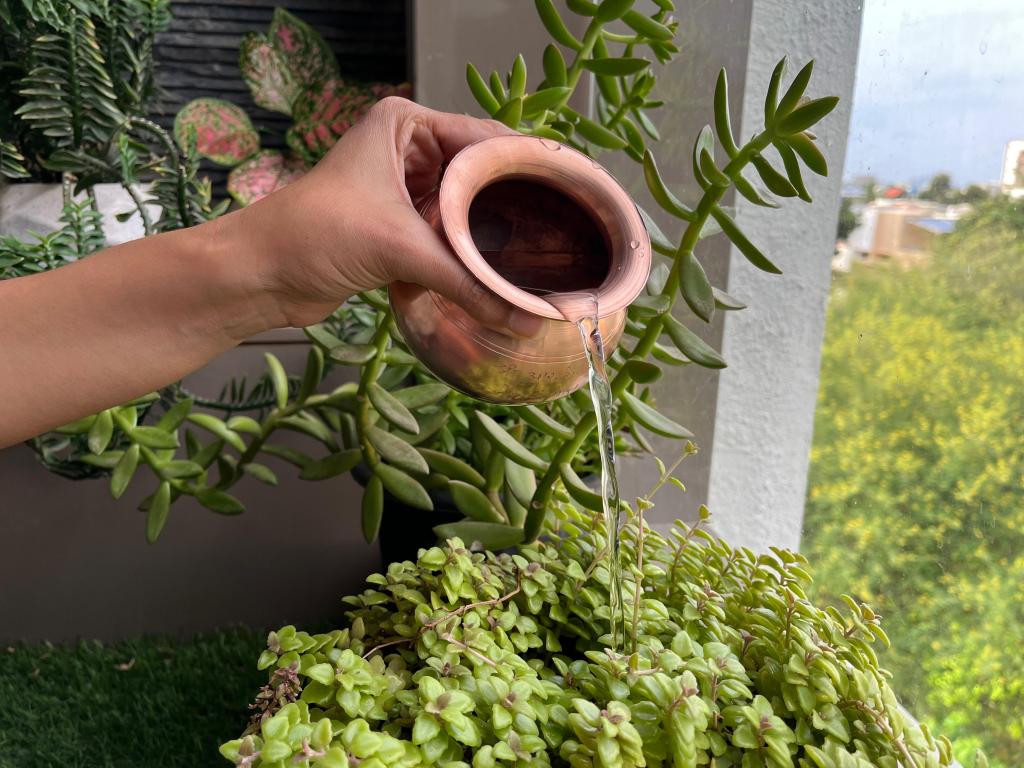
A copper lota/ kalash alongside other variants of the lota in different metals. The design of the lota makes it easy to hold and pour water without spilling.
Also called Kalash among other terms for the same, the Lota was first made during the Indus Valley civilisation, is symbolic of prosperity, purity, blessing and sanctity in Hindu culture. The very first design of the Lota was in terracotta, and was later made using metals like, brass, bronze, copper, silver, iron, etc. Even today, the Lota is an essential in almost every Hindu household for poojas, weddings and other religious and yogic practices.
The design is so simple, yet so clever; the structure of the Lota allows it to hold a lot more water than a glass and the grip at the neck makes it very easy to hold even if it is heavy. The sculpture of the mouth makes it easy to pour water, while considering the complex fluid dynamics.
In fact, in ‘The India Report’, Charles and Ray Eames write:
“Of all the objects we have seen and admired during our visit to India, the Lota, that simple vessel of everyday use, stands out as perhaps the greatest, the most beautiful. The village women have a process which, with the use of tamarind and ash, each day turns this brass into gold.
But how would one go about designing a Lota? First one would have to shut out all preconceived ideas on the subject and then begin to consider factor after factor :
The optimum amount of liquid to be fetched, carried, poured and stored in a prescribed set of circumstances.”
The report also contains an elaborate list of reasons why the Lota has excellent product design.
Traditional Indian designs are inspired from the world around us; they are organic and inspired from the natural forms around us, reminding us that creativity and innovation can be found everywhere we go, all around us.
HOW SOME THE BEST UI/UX DESIGNERS IN INDIA WORK
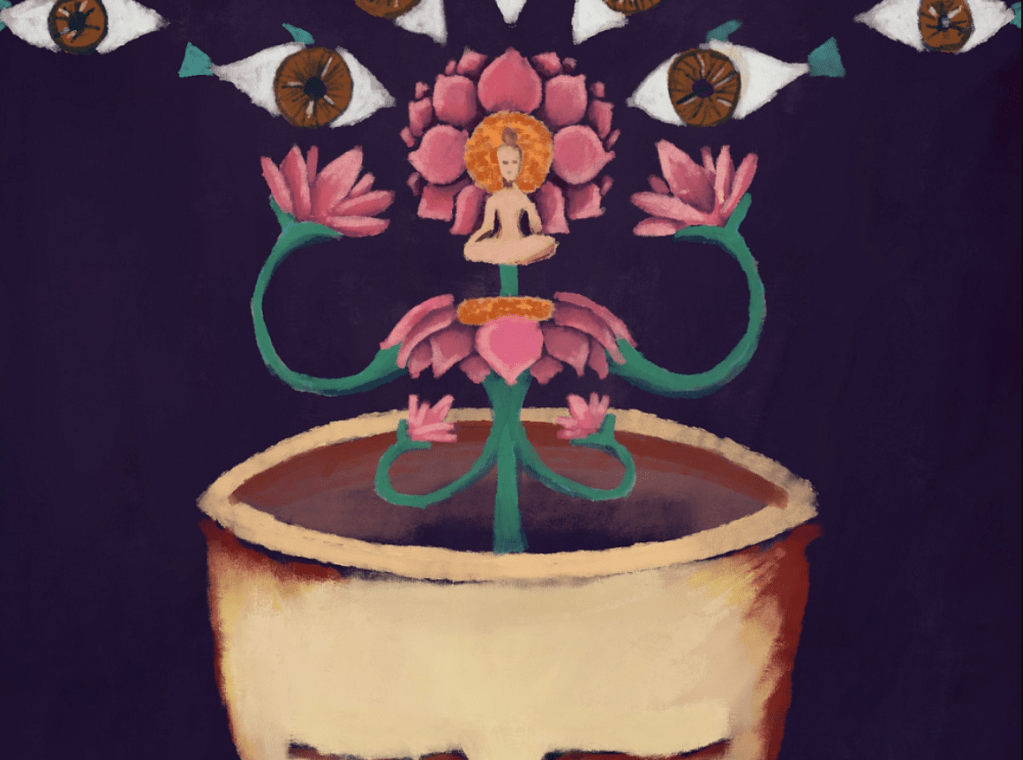
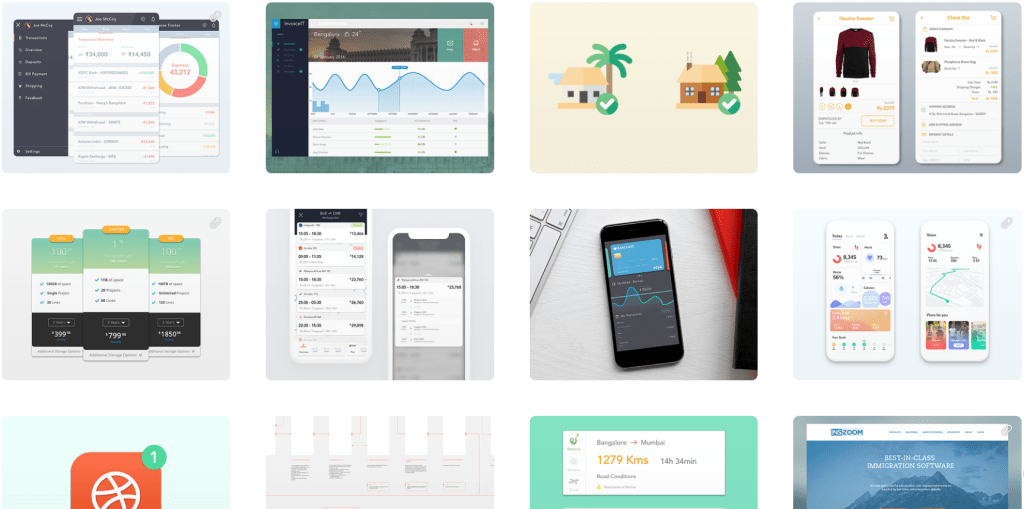
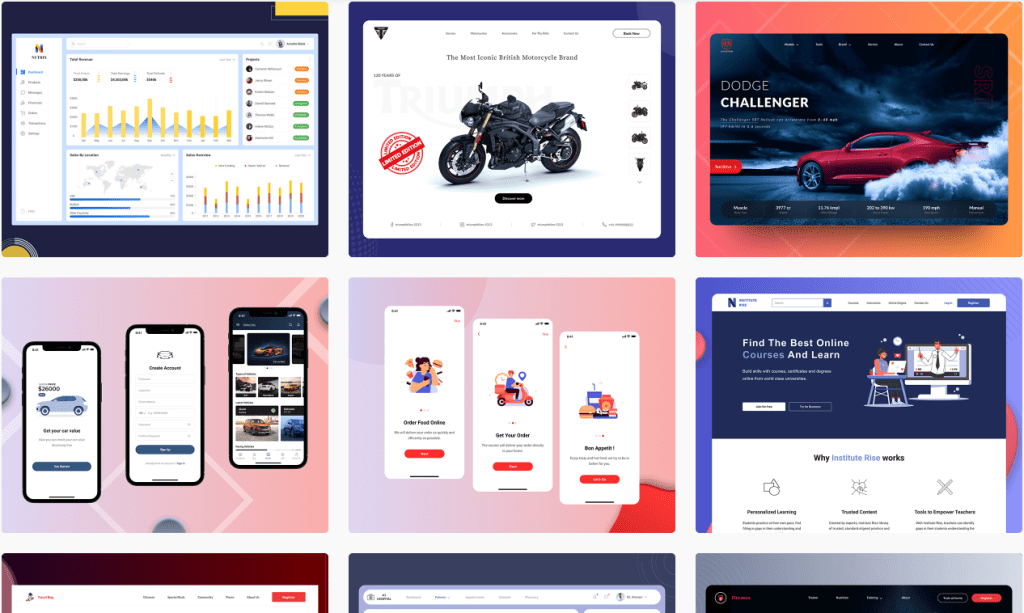
Owing to their rich Indian culture and background in art and design, Indian UI/ UX designers are definitely making the best use of their cultural legacy left behind by their ancestors.Sidharth is a UX designer/ researcher with over 10 years of experience. He creates dramatic designs and illustrations using traditional Indian iconography and symbolism; his designs are beautiful and strongly symbolic, using elements like lotuses, mandalas, a third eye, etc.
Saptarshi Prakash is a UX mentor as well as a speaker; he also conducts workshops on UI/UX design. What makes Saptarshi’s designs so eye-catching is his use of colours; he uses bold and vibrant colours in contrast with lighter ones. All of his designs are so eye-catching because of the colour and still so clean and minimal.
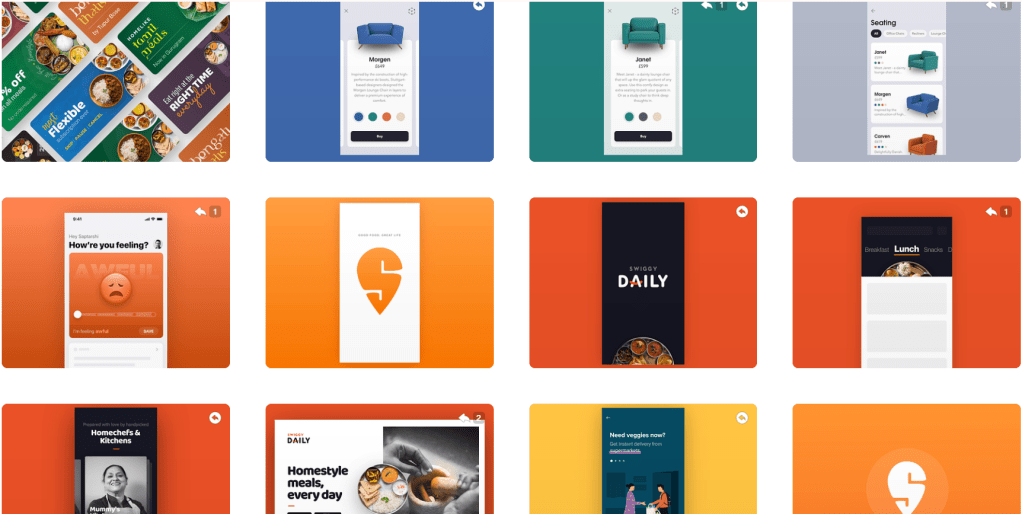
Aman Mehta, who leads UX at OYO, makes the most colourful and vibrant illustrations and Anoop Joy excels in iconography with his innovative designs. Lastly, the web page designs and UIs Rahul Saini creates are truly cinematic, just like Indian art.
CITATIONS
- Bhatnagar, A. (2021, December 15). Indian Graphic Design? – Amogh Bhatnagar – Medium. Medium. https://medium.com/@amoghbhatnagar/indian-graphic-design-4f9e14f0c5e6
- Permana, D. D. (2023, July 4). The Impact of National Culture on UX/UI Design: Unraveling cultural diversity in Digital experiences. Medium. https://bootcamp.uxdesign.cc/the-impact-of-national-culture-on-ux-ui-design-unraveling-cultural-diversity-in-digital-c6bf16b518fc
- https://www.thevoiceoffashion.com/fabric-of-india/features/crafts-and-textures-in-indias-graphic-design–5783
- Yadav, D., & Yadav, D. (2024, June 3). Lota: a Must-Have for every Hindu home. IndianShelf. https://www.indianshelf.in/lota-a-must-have-for-every-hindu-home/#:~:text=The%20evidence%20of%20the%20presence,of%20the%20world’s%20earliest%20civilisations.
- Eames, C., Eames, R., & NATIONAL INSTITUTE OF DESIGN. (1958). The India Report. http://echo.iat.sfu.ca/library/eames_58_india_report.pdf
- Introduction to Indian art. (2021). In St. Andrew’s Episcopal School, Austin, TX. https://www.phs.poteau.k12.ok.us/williame/APAH/NonWestern/NonWestern%20Misc/Indian%20Art%20Characteristics%20for%20AP.pdf
- Inspicanvas. (n.d.). Inspicanvas. https://www.inspicanvas.com/
- INDIAN CULTURE AND HERITAGE. (n.d.). In DDCE/M.A Hist./Paper-VIII [Book]. iashelpdesk.in. https://iashelpdesk.in/pdf/standard/30aa75549c71a6d922e14bedc6204c2e1b246b91.pdf
 UX Decoded.
Leave a comment